ORPHAN has been out for a couple of weeks now and is creeping humbly towards a thousand YouTube views across my channel and the band’s. Now the dust has settled, I look back at what worked well and what definitely did not.
More than anything, I’m glad I got it done. Post-production, initially a daunting task, took about six weeks in total. Although holed up in bed for health reasons, I was able to gather up all the raw footage and supplementary graphics into a single location to work with, and that helped get things going.
Rebuilding the original concept from the scraps we’d already shot was a challenge. A lot of shots had never been filmed, so I had to work out how to tell the story in other ways. Existing footage was carved up for use in new scenes, composited with stock footage to approximate the original intent, then mixed in with self-designed effects and monitor screens to bolster the narrative.
My main problem in all of this was being too precious. I had lofty ideas for particular scenes that just had to be right, and although there were no real deadlines I let opportunities for guerrilla filmmaking slide while waiting for the perfect studio shot. I wanted to get all the pieces together before filming so as not to waste other people’s time by making it up on the spot.
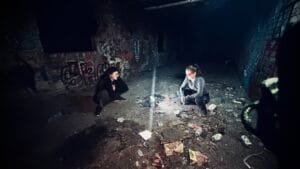
When more volunteers are brought into a project, scheduling becomes an ordeal. Co-ordinating the availability of the actress, additional crew, and locations alongside my other commitments was a challenge I often struggled to overcome. The best days were when the stars aligned and we had a small crew shooting on site, expanding on ideas and working together to make the in-camera effects happen. It is no surprise that when momentum stalls in anticipation of the right moment, talented creatives just lose interest and move on.
A lot of these complicated scenes could have easily been replaced by simpler, quicker shoots at more accessible locations. Experience teaches you to both trust yourself to tell the story with the resources available and the audience to follow the narrative without being spoon-fed. The trick is to balance the ideal with the practical, and to be prepared to let go of that which doesn’t work on the day.
Trust does not mean “Trust me, bro!”, and communication on my part was lacking at the start of the shoot. The great ideas I had for the film were often internalised, making it harder to bring others on board.
Although I had ideas for how I wanted the extra effects to look, especially the city scenes, they were limited to concepts and not specific compositions. 3D artists were approached to work on both the city and fabricated props, and some very rough mockups were produced. But without a glimpse of the ‘big picture’ from my side they couldn’t contribute as much as they wished to. Trust also means trusting in others.
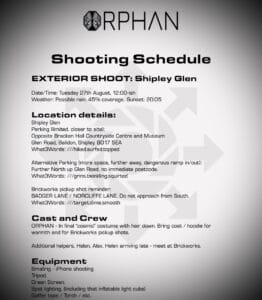
For the days of filming, I prepared an ad-hoc Shooting Schedule, listing the shots we’d film on the day, where to gather (What3Words helped for navigation), expected weather, and how we’d be going about it. Where in-camera effects were implemented, this also included information about slow motion, reversing footage, greenscreen, and the like.
However, there was no shot-by-shot master document, showing how everything would fit together in the final release. Although I wrote a brief plot synopsis early on, I found a separate storyboard video – delivered months into the project – better to illustrate intent. This could have fed into such a master document, ensuring each shot was listed and accounted for even if the practical details were still hazy.
Something I’ve learned from creative endeavours on campus is that complex projects live and die in their documentation. Even if I don’t have all the answers right away, getting things written down helps others to spot the gaps and offer their input, while also highlighting where the budget will be needed. Documentation should be the starting point of shared understanding, evolving alongside the project without suffocating spontaneity.
On the run-up to release, I made sure all stakeholders were involved, with regular preview cuts showing work in progress. Having that extra scrutiny proved essential for keeping me on track during the final weeks.
I could have just cheated in all of this and used generative AI to bring everything to screen. I experimented at the start of the project to fill out the storyboard, but took the very deliberate decision to keep it real and especially human in the final cut. Anything else would be unacceptable.
The work was harder, with effects compositions done by hand using an ever-expanding knowledge of the tools, but the process itself proved much more worthwhile. There were more important lessons to be learned from both achievement and setback than if I’d just hammered out prompts.
The release to YouTube was a problem in itself, with a separate copy delivered to the band’s channel as well as my own. This wasn’t ideal, as it split visibility between the two, and the correct collaboration process was poorly documented. (Hidden behind an innocuous ‘Show More’ link.) Next time, I’ll know to just upload once and use these collaboration tools to share the release across relevant channels.
There was a lot riding on this film, not least my vested interest in making it as awesome as possible. Although I expected a lot of criticism, I’ve found the response to be overwhelmingly positive. Creatives often underestimate how good their work can be, especially after spending so long on a project that perspective narrows to the few remaining flaws. Although constructive criticism is welcome, those who wish to find fault will find it regardless. It’s always better to release something that’s close to ideal than keep polishing for perfection that never comes.
As the wisest philosopher of our generation once said, “Hindsight is always twenty-twenty.” If I could turn back time like the eponymous heroine of the story, I’d do things differently. I’d get out there and get things done sooner, making the most of momentum while everyone involved is still interested. I’d make sure I had every scene roughed out in the schedule, giving others something to work from and build upon. I’d establish credibility by involving everyone and being open with them from the outset. Even the greatest concept cannot thrive in isolation.
But it’s done, it came out exactly when it needed to, and I’m proud of the end result. Now I can move on to the next challenge!