This is probably the first, last, and only time I’ll ever mention the former “Bad Boy” of “Pop”.
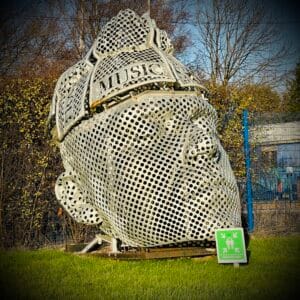
A common motif scattered around the Academy campus is the visage of Robbie Williams. Site-based stage innovators TAIT have built scenery for his prior productions, with the larger than life result donated afterwards to make an effective fire assembly point. In wintry weather I observe it’s not the first time he’s had snow on his nose.
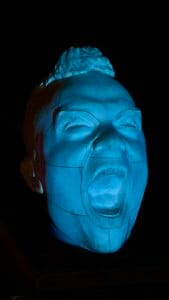
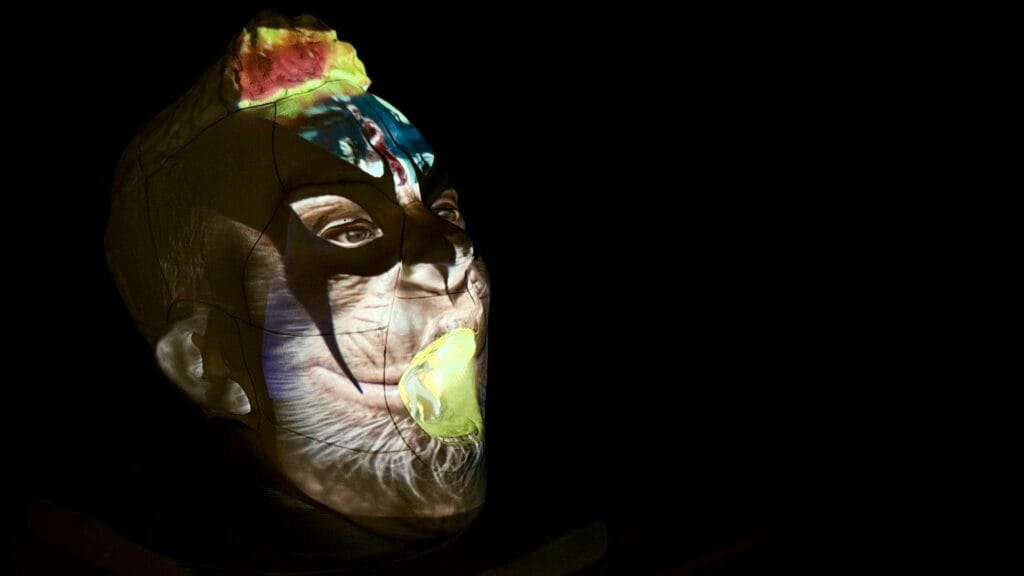
On a smaller scale, a 3D-fabricated sculpture of his face provided a challenging projection mapped surface as my Visuals module heads toward end-of-term assessment. Indulging a desire to integrate facial projection into future projects, this was the ideal static subject to try things out over a few hours of experimental studio time.
Despite any knowledge of his career purely culled by cultural osmosis (really!), I was able to piece together a collage of clips to represent the journey. With a simian base layer invoking the Better Man biopic, I swiftly incorporated his more recent cartoon appearance on a certain cat food commercial. Going back to the KISS-inspired makeup from “Let Me Entertain You”, the montage was topped off with the skin-stripping coda to the “Rock DJ” video. Looping that segment through the projector’s tinny speaker was sufficient to get everyone’s toes tapping – whether they wanted to or not.
Sourcing the elements in short notice was a challenge within itself, necessitating some quick thinking across many resources and creating new ones on the fly. But for a dabble it did the job nicely – despite a few imperfect keystone masks and off-centre aspects.
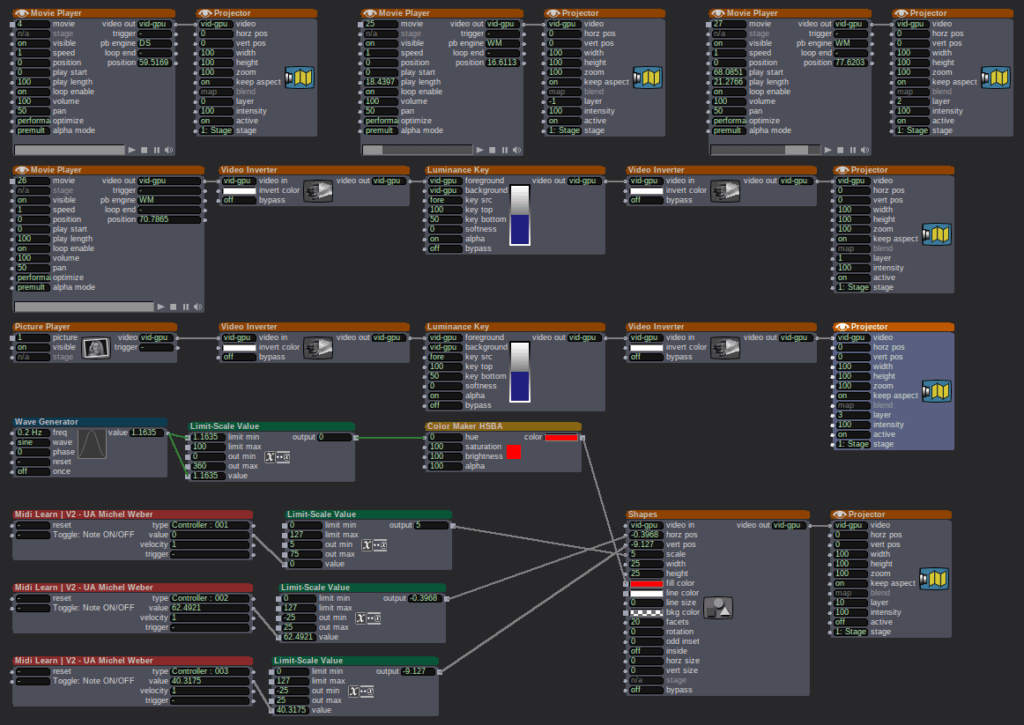
Although my studies and assessment focus on mastering Green Hippo media servers, I took the opportunity to try something different. Cracking open the case for the first time on our prized Troikatronix Isadora server, I soon found myself a quick learner.
Green Hippo has a warm, organic user interface that sometimes seems counter-intuitive despite its obvious power. Isadora presents a more familiar building-block style of boxes and properties, allowing links to be dragged between outputs and inputs to visualise how everything is hooked up.
My familiarity with node-based workflows such as DaVinci Resolve Fusion, combined with my coding background, made getting to grips with Isadora a cinch. Although I can understand how the blank starting screen can seem intimidating to non-techies.
Although there are likely far more efficient ways to structure my little throw-together, I was able to coax the effect I wanted by combining smaller known sub-processes. This combination of nodes and lines offered mathematical means to make it work where I may have floundered with an artier interface…
… so I guess I’m loving angles instead.